How do pivot irrigation systems move
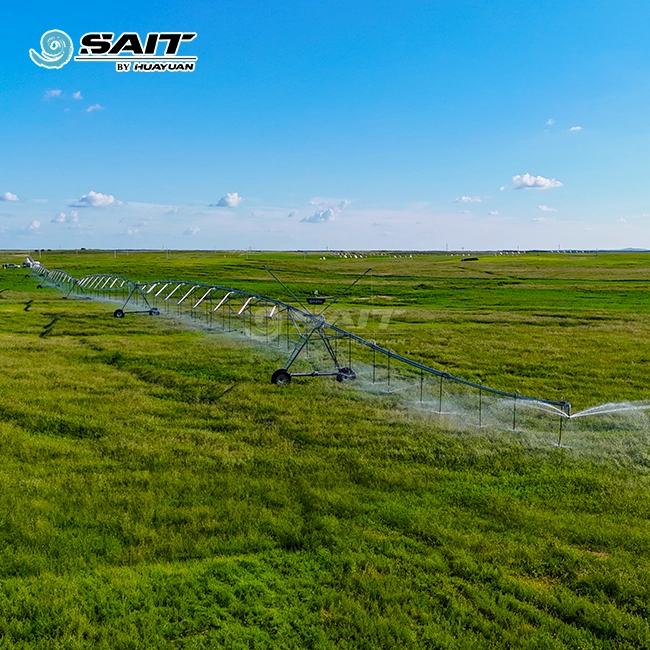
Pivot irrigation systems move through a precisely coordinated sequence of electric motors, gearboxes, and control signals. Each tower along the lateral pipeline carries its own drive unit, and when the control panel sends a command, every tower advances in a synchronized arc around a stationary center pivot point. The result is a continuous circular sweep that delivers water uniformly across the field. Understanding this movement mechanism helps procurement engineers, large-scale farm operators, and EPC contractors evaluate system reliability before committing to a capital investment.
Understanding the Movement Mechanism of Pivot Irrigation Systems


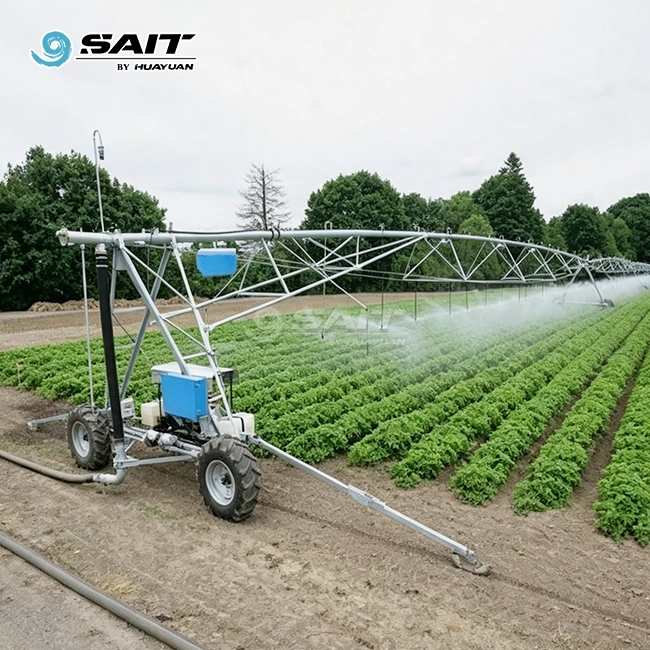
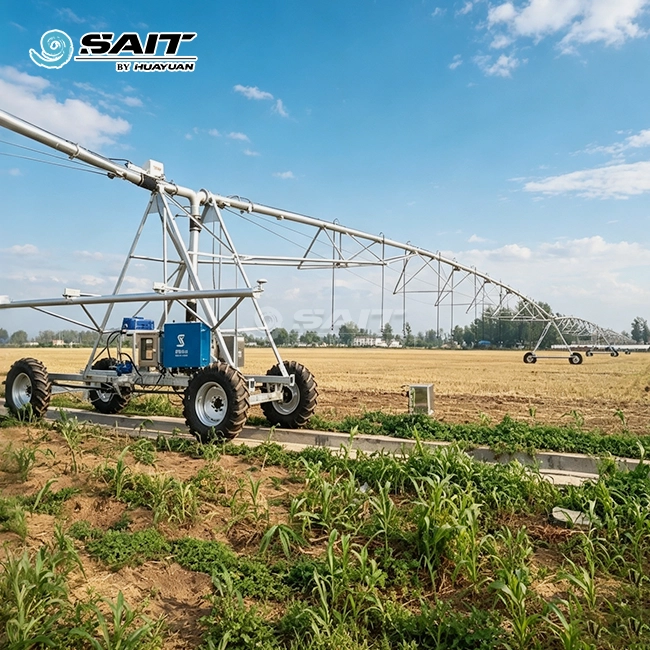
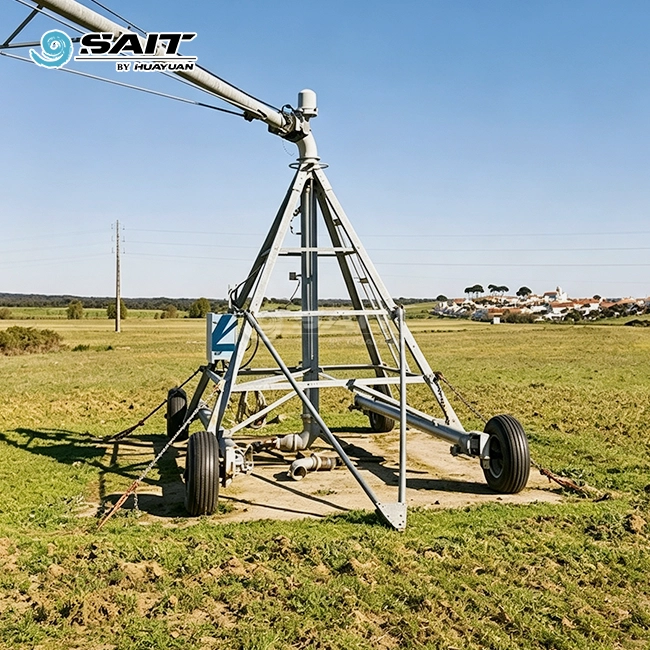
A pivot irrigation system does not depend on a single motor to move the whole thing. Instead, each tower has its own separate drive assembly that works with the same control signal to keep the side pipe straight and the structure's stress levels manageable during the rotation cycle.
Each tower has a gearmotor that turns electricity into wheel movement. There are two gearmotor ratios used by HUAYUAN SAIT systems: 25.5:1 at 1.5 hp for faster travel and 40:1 at 0.75 hp for slower travel with high torque. This works with wheel gearboxes that have a reduction ratio of 50:1 or 52:1. This lets operators fine-tune the ground speed. The UL-listed, protected wire that runs the whole length of the span gives each tower the same amount of power, no matter how long the field is.
Tower Drive Units and Gearmotors
Each tower houses a gearmotor designed to convert electrical input into consistent mechanical torque. By utilizing specific gear ratios, the system allows for precise control over the rotation speed, ensuring that the lateral pipeline maintains its intended path across the field surface.
Alignment Control and Safety Logic
Microswitches or GPS-assisted sensors that measure angular variation between neighboring spans keep an eye on the tower's orientation. When one tower moves ahead or behind, the control system slows down or stops that unit until it is back in sync. This self-correcting reasoning stops pipes from bending, keeps the structure strong, and keeps the hot-dip galvanized truss kits, which are made with 20 mm or 22 mm truss rods, safe from building up fatigue stress.
Tire and Ground Engagement
Choosing the right wheel size for pointer-type irrigation is more important than most people think. HUAYUAN SAIT has three wheel sizes: 11.2-24, 14.8-24, and 16.9-24. These wheels come with or without tubes. Wider tires spread the weight of the tower over more ground, which keeps the drive grip stable and reduces the depth of ruts. This ability to adapt is especially useful for fields with a lot of clay in the U.S. Corn Belt or sugarcane plantations that get too wet in tropical areas.
Evolution and Technology Behind Pivot Irrigation Movement
Flood irrigation has been the main method of large-scale gardening for many generations, but it wastes a lot of water and requires a lot of work. According to a study released by the USDA Economic Research Service, pivot irrigation systems now cover about 80% of all irrigated cropland in key U.S. states. This change is due to automation and better movement efficiency.
From Manual Trenching to GPS-Guided Rotation
Early mechanized pivots used hydraulic drives that often leaked and didn't work well for controlling speed. Digital control takes the place of complicated hydraulics in modern electric-drive systems, such as the ones used in the SAIT precision irrigation platform. BeiDou satellite tracking now guides the extension and retraction of the corner arms. This results in a missed-irrigation rate below 5% and a distribution regularity above 90%, which are typically higher than industry standards. IoT connection lets workers check the position of the towers, the moisture of the soil, and the flow rate from a smartphone or a farm management dashboard. This means that regular cycles don't need staff to be on-site.
Core Operational Steps
The user sets the direction, speed, and application depth at the control screen to start a pivot cycle. These data are turned into synced motor orders along the whole lateral by the SAIT Smart Control System. The speed limit is always changing. The outer towers move faster because they cover a wider circle, so the system changes the run time to keep the same rate of precipitation across all spans. When the ground isn't level, universal joints between span sections let the structure bend up to 15 degrees vertically. This keeps all towers in place and all guns at the same height.
Benefits of Pivot Irrigation Movement for Global B2B Clients
Pivot irrigation technology is different from stationary drip lines or fountain laterals that are moved by hand because it moves in a circle automatically. At a business level, the practical benefits add up quickly, and procurement teams that care about total cost of ownership will find the numbers convincing.
The HUAYUAN SAIT method is great for large-scale processes because of the following:
- Water conservation at scale: The system saves more than 70% more water than the old way of flood irrigation. One unit can work on anywhere from 4 to 200 hectares per cycle, so it can be used for demonstration plots for small farmers all the way up to state farm projects that cover more than 1,000 hectares. Integrated fertigation lowers input costs even more by putting nutrients directly into the pivot irrigation systems water.
- Structural durability for harsh environments: Hot-dip galvanizing with a zinc covering that is at least 80 μm thick makes a barrier that protects better than regular electroplated coats by a large amount. With self-made virgin PE pipes that don't contain any recycled material, the system is designed to last more than 20 years in temperatures ranging from -20°C to 60°C, making it useful for use in both Kazakhstan's continental winters and Egypt's desert summers.
- Span and profile flexibility: There are span lengths ranging from 37.5 m to 66.5 m and profile heights ranging from 2.1 m to 4.5 m. These range from normal row crops to high-clearance setups that can handle tall corn or sugarcane. Different field sizes need different flow rates, so pipeline widths of 5", 6-5/8", and 8-5/8" can be used.
Increasing water costs, unreliable field labor, and equipment that breaks down quickly in harsh outdoor conditions are all problems that procurement officers at large farms and EPC contractors often have to deal with. All three problems are solved by the SAIT platform, which comes in a single, scalable package.
Troubleshooting and Maintenance Tips for Pivot System Movement
Movement reliability over a 20-year period depends on regular preventative maintenance instead of repairs that are needed after the fact. It is normal practice in the industry to change the oil in the gearbox once a year and grease all the pivot joints before the busy watering season. The HUAYUAN SAIT comes with a 1-year full warranty, 3-year low-cost maintenance coverage, and spare parts that are supplied at factory cost for life. This takes away the financial insecurity that often slows maintenance choices.
One common movement problem in pointer-type irrigation, and its easy fix, is motor stalling due to wet soil. This can be fixed by switching to high-flotation tires and turning on computerized anti-stall logic that detects wheel slip and automatically changes speed. Moisture getting into control panels is a common cause of problems. SAIT panels have lightning arrestors and phase-monitoring switches that protect against the changes in the rural grid that are common in Africa and Central Asia. The GPS-guided tower sequence stays exact because the alignment sensors are software-calibrated at set times every season. This stops the span from bowing, which shortens the pipe's service life.

Making Informed Procurement Decisions on Pivot Irrigation Systems
To find the right system for your field, you need to look at more than just the unit price. You need to look at the motor energy draw, span configuration, terrain profile, and vendor support depth. In the U.S. market, Valley, Lindsay, and Reinke are all well-known brands, but their wait times and after-sales services are very different outside of North America. Because HUAYUAN SAIT is based in a transportation hub next to Xuzhou and has direct access to Suzhou's export network, they can produce basic setups in as little as one week and custom corner arm or boom-back attachments in 30 to 45 days.
With more than 130 patents, including 35 invention patents and 15 foreign patents, the company has a real R&D infrastructure that was built with the help of China Agricultural University through local engineering research center programs. Regional wholesalers can use private-label branding on tower boxes, control panels, and sprinkler packages with OEM and ODM services. Confidential settings are protected by NDAs. Pilot orders start at a single unit, which lowers the financial risk of field demonstration programs before they buy in bulk.
Conclusion
It's easier for procurement professionals to judge long-term success when they know how pivot irrigation systems work, with their synced tower motors, self-correcting alignment logic, and GPS-guided corner arms. When you combine engineered structural parts, smart automation, and adaptive terrain management, modern center pivot technology is the best way to grow crops on a large scale with the least amount of water and labor. The HUAYUAN SAIT's flexible span choices, long-lasting galvanized construction, and full after-sales service turn its technical excellence into measured practical value for farms, builders, and wholesalers all over the world.
FAQ
Q1: How does the system maintain uniform water application across different span lengths?
The size of the nozzle opening grows as the radius does. Larger orifices release more water per pass to make up for the fact that outer spans cross a longer arc in the same amount of time. The SAIT system's exit spacing can be changed from 1.9 m to 2.9 m, which lets the nozzle layout be precisely tuned to match the rate of soil infiltration and the structure of the crop cover.
Q2: Can the pivot operate on sloped or uneven terrain?
Up to 15 degrees of vertical flexibility is provided by universal joints between span sections. This keeps all towers in contact with the ground even when the ground is slightly uneven. Row crops can also be grown on sloped areas with high-clearance towers that are up to 4.5 m high.
Q3: How often should gearboxes be serviced?
Planetary gears made for industry are designed to last 10,000 hours or more. For practical upkeep plans, the oil should be changed every 1,000 hours of use, and the joints should be checked thoroughly before each growing season.
Q4: What happens during a high-wind event?
When local weather data is combined with telemetry, the SAIT Smart Control System can automatically park the lateral in a wind-safe position. This keeps structural parts from being damaged by lateral loads.
Partner With HUAYUAN SAIT — Your Trusted Pivot Irrigation Manufacturer
HUAYUAN SAIT has been making products for 20 years, has more than 130 patents, and offers a full OEM/ODM service. They make pivot irrigation systems that are built to work on a large scale. Our engineering team helps you with everything from site planning to installation, whether you need a single unit for a test or 20 units for a project. To get a custom system proposal right away, email us at kevin@showyirrigation.com.
References
1. USDA Economic Research Service — Irrigation & Water Use: Overview, 2023.
2. American Society of Agricultural and Biological Engineers — ASABE Standard S436.1: Test Procedure for Determining the Uniformity of Water Distribution of Center Pivot and Lateral Move Irrigation Machines, 2021.
3. Food and Agriculture Organization of the United Nations — Crop Water Requirements and Irrigation Scheduling, FAO Irrigation and Drainage Paper No. 56, 2022.
4. Agricultural Water Management Journal, Elsevier — Energy and Water Use Efficiency of Center Pivot Irrigation Systems in Semi-Arid Regions, 2022.
5. National Academies of Sciences, Engineering, and Medicine — Science Breakthroughs to Advance Food and Agricultural Research by 2030, 2019.
6. Irrigation Science Journal, Springer — Variable Rate Irrigation Scheduling Using Soil Moisture Sensors and Remote Sensing Data, 2023.
Get a tailored irrigation solution for your project — our engineering team is ready to support you from design to installation.