What is the advantage of pivot irrigation?
Pivot irrigation delivers exceptional water use efficiency, automation, and scalability—saving over 70% more water compared to traditional flood methods while covering 4 to 200 hectares per cycle. Through precise, uniform application enabled by rotating sprinkler systems, center pivot technology reduces labor demands, enhances crop yields, and adapts seamlessly to diverse terrains and climates. For large-scale operations managing row crops or government-funded agricultural programs, this automated solution addresses critical challenges like labor shortages, water scarcity, and uneven crop development while ensuring measurable return on investment.
Understanding Pivot Irrigation: Definition and Core Components
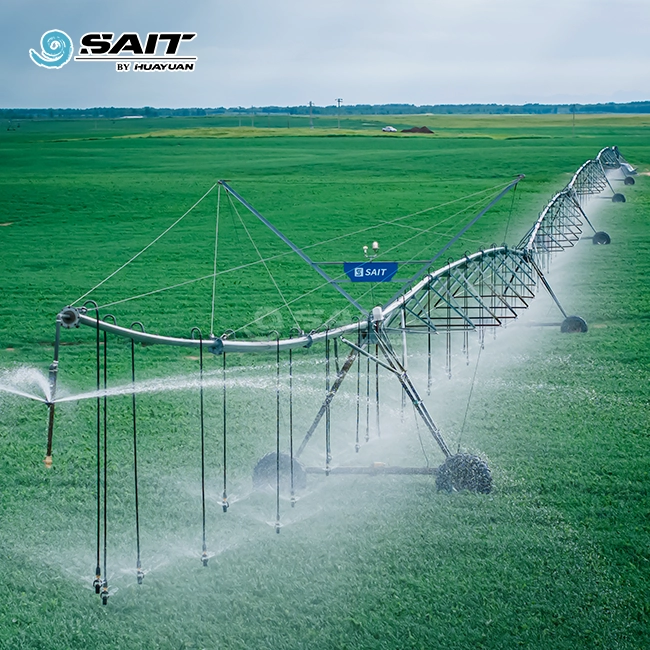
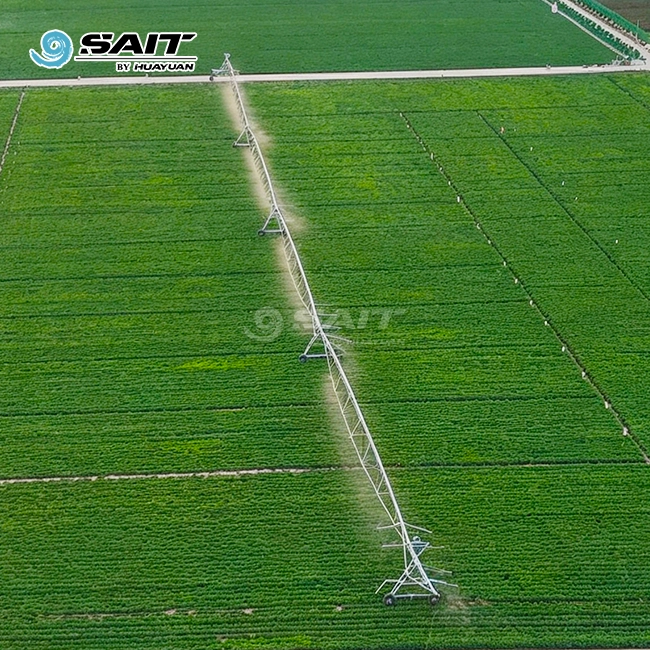
Pivot Irrigation uses a complex mechanical system in which a pipeline held up by galvanized steel struts turns around a set middle point. From the pivot hub, water runs through spans that are usually between 37.5 and 66.5 meters long and are attached to mobile towers that have electric motors and wheel gears with them. Each tower moves in sync with the others, making a circle pattern of watering that covers the most ground.
Core Structural Elements
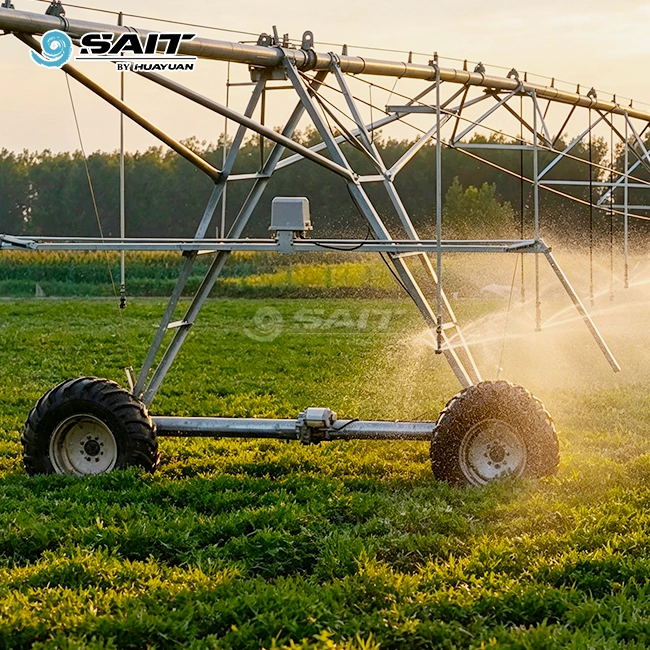
The major feature of the system is hot-dip galvanized steel spans with truss rod and angle frames to appropriately distribute load. Pipeline requirements typically include 5 inches (127mm), 6-5/8 inches (168mm), and 8-5/8 inches (219mm) diameters to manage flow rates for 50–800-meter operations. Span heights range from 2.1 meters for low-profile crops to 4.5 meters for sugarcane and biofuel crops. Overhang lengths vary from 2.7 to 25 meters depending on field design.
Precision Water Delivery Mechanism
Adjustable sprinkler packages at 1.9-meter or 2.9-meter intervals provide variable-rate watering in modern systems. As you approach the span edges, the nozzles grow. This compensates for increased rotating speeds and ensures over 90% dispersion. Advanced control systems like SAIT Smart Control employ soil moisture and weather sensors to adjust watering on the fly. This prevents crops from overwatering or flowing off while meeting their needs.
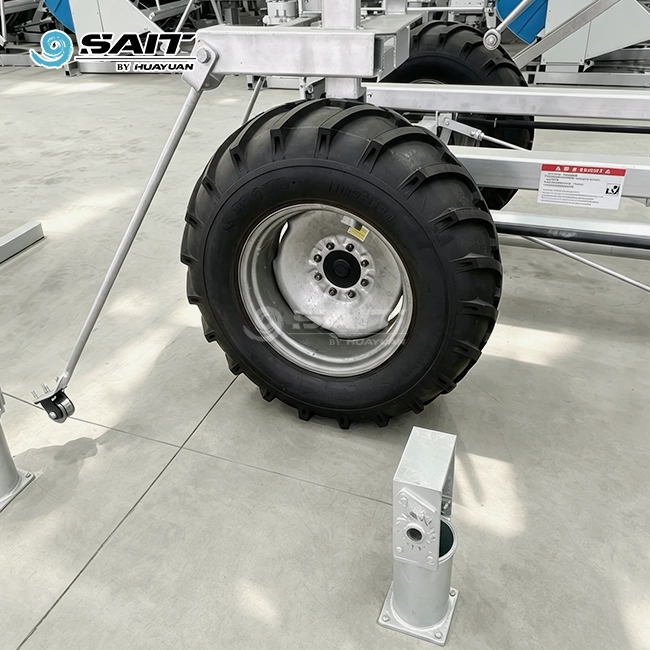
When buying these systems, managers should remember that wheel configurations—11.2-24 to 16.9-24 with or without tubes—affect how effectively they grip and travel on different terrains. Tower movement is controlled by 25.5:1 or 40:1 gearmotors, while wheel gearboxes with 50:1 or 52:1 ratios offer torque for muddy fields or steep terrain.
Key Advantages of Pivot Irrigation Systems
Commercial farms and government agricultural departments consistently put this technology at the top of their lists because it improves operations in a number of ways that can be measured. Pivot Irrigation systems consistently deliver higher efficiency across diverse environments.
Water Conservation and Efficiency
Traditional flood irrigation wastes water by evaporating, seeping, and running off. Center pivot systems manage water flow to root zones, reducing water consumption significantly. If you set up your system correctly, you may attain irrigation consistency rates of 90%, so every plant receives enough water without too much. This precision saves over 70% more water than surface flooding. This is a big benefit in areas with depleting aquifers or water restrictions for crops.
Labor Reduction and Automation Benefits
Manual irrigation requires hand-adjusting gates and constant field monitoring. Scheduled and remote-controlled automated center pivot systems eliminate these demands. Workers may change spinning speeds, start/stop times, and application rates for each zone on numerous machines using their phones using the SAIT Smart Control System. This technology is especially useful for organizations that operate 500-hectare properties and have high personnel expenditures.
Scalability Across Diverse Operations
Center pivot technology can water 50-hectare plots or 200-hectare government food security programs. A modular span arrangement lets it adapt to diverse demands. Turnkey agricultural engineering businesses might request unique span lengths, tower heights, and corner arm extensions to cover uneven areas. The system can manage massive wholesale sales of 5 to 20 units and one-unit trial setups for demonstrations due to its flexibility.
Enhanced Crop Performance
Crop health and productivity depend on regular water delivery. Center pivot systems maintain soil moisture throughout the growing season, unlike flood irrigation. Integrated fertigation delivers nutrients dissolved in irrigation water simultaneously, increasing plant uptake and lowering fertilizer expenditures. Cotton, corn, soybean, and wheat farmers report that regular irrigation and less plant stress have increased yields.
This strategy is better for the environment. Controlled application prevents nutrients from seeping into groundwater, prevents soil erosion, and consumes less energy than high-pressure spray. Sustainability traits described below align with corporate responsibility aims and tighter North American farming environmental standards.
Pivot Irrigation vs. Other Irrigation Methods: Making the Right Choice
To make good purchasing decisions, you need to know how the different technologies compare in terms of performance so that your investment fits with your needs and your budget. Choosing the right Pivot Irrigation setup requires an analysis of infrastructure and water availability.
Efficiency and Operational Cost Analysis
People often say that drip irrigation saves 90–95% of the water it uses, but it needs a lot of work to be installed below ground, and the emitters need to be maintained. The cost of installation is between $1,500 and $3,000 per acre, and the system is very likely to get clogged by mineral deposits or plant growth. The starting cost of a center pivot system is usually between $50,000 and $200,000 per unit, based on the configuration. However, they require less maintenance and can last more than 20 years if they are properly maintained.
Lateral move systems cover a rectangular field, but they need power or water supply lines to be dug out in the middle of the field, which makes the infrastructure more complicated. Center pivot setups only need one connection point, which makes connecting the electricity easier and cuts down on the time it takes to build. This simplified method helps EPC project companies that are working on tight deadlines or in places with poor electricity infrastructure.
Technology Integration Capabilities
Control system sophistication is what sets leading makers like Valley, Lindsay, and Reinke apart from new rivals like HUAYUAN SAIT. Both Valley's BaseStation3 and Lindsay's FieldNET systems offer full telemetry and GPS tracking, but they usually come at a higher cost. When BeiDou navigation is added to SAIT Smart Control Systems, corner irrigation coverage is achieved with missed area rates below 5%. This solves a long-standing problem in the industry where standard fixed-radius systems leave corners without watering.
When figuring out the total cost of ownership, procurement teams should look at brand-specific factors like how easy it is to get spare parts through established dealer networks, how long the guarantee lasts (1-3 years), and how well it works with current farm management software. International wholesalers like it when suppliers offer private label branding choices and open MOQ requirements for OEM partnerships.
Common Challenges and Maintenance Tips for Pivot Irrigation
Whether capital investments pay off as planned or cause costly downtime during key growth periods depends on how reliable operations are. Maintenance of Pivot Irrigation machinery is essential for ensuring a service life exceeding two decades.
Mechanical Wear and Preventive Care
Gearboxes are the most common place where things break, and they usually need to be oiled every 1,000 hours of use to keep them from wearing out too quickly. For high-quality planetary gears with 10,000-hour or more service lives, the maker specifies the viscosity grades that must be used for lubrication. Tower alignment problems happen when microswitches or GPS guiding systems get out of whack, putting stress on the pipeline and possibly causing a span to break. Regular checks of the alignment using laser tools stop damage to the structure and keep the irrigation even.
When it's wet, wheel slip makes the tower stop turning and spin unevenly. Options for high-flotation tires and anti-stall logic systems can sense when traction is lost and adjust the motor power or briefly change the direction of travel to get it back. Every month, operators should check the tire pressure and replace old treads before things get worse on the field.
System Performance Verification
When nozzles get clogged, pressure controls stop working, or pipeline leaks happen, distribution becomes less even. Every year, catch-can tests are used to make sure that the actual rates of precipitation match the design specifications. For these field tests, collection containers are placed at regular intervals along the length of the span. The span is then turned around once, and the volume of material collected is measured. If the results vary by more than 10%, it means that the tip packages or pressure settings need to be changed.
Before each irrigation season, electrical parts like lightning arresters, motor controllers, and armored cables need to be checked. UL-listed wire standards protect against water damage and physical damage. However, damage from rodents or corrosion at junction boxes can cause intermittent problems. Phase-monitoring relays keep motors from overheating when the power supply is unstable, which can happen in rural areas where voltages can change quickly.
Professional Service Partnerships
Repairs that are too complicated and need structural welding, setting of control panels, or analysis of hydraulic systems are beyond the skills of most farm maintenance workers. Setting up relationships with approved service providers before problems happen makes sure that help is on the way quickly in an emergency. As standard with HUAYUAN SAIT systems, suppliers who offer on-site installation supervision and technical advice teach farm staff how to run the systems, which reduces the need for outside techs in the long term.
Procurement Guide: How to Source and Invest in Pivot Irrigation Systems?
When you use strategic sourcing, you have to weigh the upfront costs of cash against the long-term savings and improvements in production and operations. Investing in Pivot Irrigation solutions requires a detailed understanding of total cost of ownership.
Budget Planning and Financing Considerations
The price of a system depends a lot on its coverage area, how it is configured, and how much automation it has. A simple 50-hectare system with basic settings costs around $80,000 to $120,000. The most expensive 200-hectare systems, with VRI and corner arms, cost around $180,000 to $250,000 to fully outfit. Government farming offices that pay for food security programs can often get loans from the World Bank or the Food and Agriculture Organization (FAO) with good terms. For commercial operations, leasing equipment that fits payments with harvest cash flows is a common way to get it.
Custom designs cost 15–30% more, but they provide real value through engineering that is tailored to the spot. When standard catalog equipment can't meet operational requirements because of things like irregular field layouts, the need to integrate with existing SCADA platforms, or the need for specialized crop clearance, it's worth making an extra investment. To make sure they stick to their budgets, procurement managers should ask for detailed cost breakdowns that separate base equipment, optional attachments, shipping costs, and installation services.
Supplier Selection Criteria
Authorized dealers and direct makers each have their own benefits. Established sellers in North America offer a local stock of popular replacement parts, expert help in English, and knowledge of how to meet USDA component requirements and ASABE standards. Direct factory sourcing, especially from companies like HUAYUAN SAIT that can export a lot, lowers unit costs by cutting out the middleman. Quality is maintained through ISO 9001 certification and thorough export documentation.
When buying things internationally, you have to think about wait times (usually 60 to 90 days from when you confirm the order until the goods arrive at the port) and the possibility of having to pay import duties. Suppliers with a yearly production capacity of more than 1,800 units show that the supply chain is stable and can commit to regular delivery dates, which are important for getting ready for planting season. Checking the hot-dip galvanizing thickness—at least 80 micrometers, according to ASTM A123 standards—keeps things from rusting too quickly in places with a lot of chemicals or high humidity.
Installation and After-Sales Support
Installing equipment correctly is very important for how well it works, so setup services offered by suppliers are a good idea. Professional installation teams make sure that the pivot points are put in the right place, that the electrical links meet local codes, and that the system is calibrated for the first time. Training programs for farm workers that cover routine maintenance, fixing common problems, and how to use control systems make sure that equipment is always working.
Most warranties cover everything for one year, but you can choose to have your maintenance deals extended for an extra year. HUAYUAN SAIT's service model includes a free guarantee for one year, low-cost maintenance with parts replacement for three years, and forever access to extra parts at cost prices. This takes care of a major worry for operators handling remote sites where lack of parts causes long periods of downtime. To avoid confusion, the specs for the purchase should clearly state what warranties don't cover, how long they promise to respond, and that parts will be available.
Conclusion
Pivot Irrigation technology has huge benefits for businesses, government programs, and agricultural contractors who want to save water, cut down on labor, and make sure crops always do well. This technology is the standard for mechanical farming because it has been shown to save more than 70% of water, can be automated to reduce the need for human control, and can be used on fields ranging in size from 4 to 200 hectares. In addition to unit price, procurement experts need to look at the total cost of ownership of a supplier, which includes things like the quality of technical support, the number of spare parts that are available, and the amount of upkeep that needs to be done. HUAYUAN SAIT is competitive for both normal bulk sales and OEM partnerships that need site-specific engineering because it uses hot-dip galvanized construction, SAIT Smart Control precision, and a variety of customization options.
FAQ
Q1: How does corner irrigation improve overall field coverage?
Modern corner arm attachments move out and back automatically with the help of GPS as the system turns, so they can reach places other than the standard circle pattern. This technology makes effective watering coverage about 15% higher, turning places that weren't getting watered before into useful farmland. The SAIT control system gets missed irrigation rates below 5%, which is a lot better than standard fixed-radius setups that don't water a lot of corner land.
Q2: What maintenance schedule ensures optimal system longevity?
Changing the gearbox oil once a year with lubricants recommended by the maker stops early wear. Before the season starts, electrical connections, tire pressure, and nozzle state are checked to find problems before they happen in the field. Every two to three years, check the alignment of the towers and test the catch-can spread to keep the level of regularity above 90%. When maintenance instructions are followed consistently, systems built with quality truss rod materials and galvanizing that is at least 80 micrometers thick usually last longer than 20 years. Pivot Irrigation systems require this level of care to reach their maximum operational potential.
Q3: Can existing systems integrate with modern farm management platforms?
Most center pivot systems made in the last ten years can be upgraded to include data and GPS direction. For third-party SCADA integration to work, the controllers must have open communication protocols. However, interoperability may be limited by proprietary systems. When HUAYUAN SAIT equipment is first installed, it is compatible with SAIT Smart Control. This means that it can be operated remotely, have its schedules automated, and have its rate of irrigation changed without having to make expensive aftermarket changes. During the seller review process, the procurement specs should check that the control system compatibility requirements are met so that the new system can work with the current farm management infrastructure without any problems.
Partner with HUAYUAN SAIT for Your Pivot Irrigation Solutions
HUAYUAN SAIT has been making products for 20 years and has advanced BeiDou navigation integration and full OEM capabilities. They serve wholesale distributors, government contractors, and farm engineering companies all over North America. Our Pivot Irrigation systems have hot-dip galvanizing that goes beyond 80 micrometers for great rust resistance, span lengths that can be changed from 37.5 to 66.5 meters, and a maximum working radius of 800 meters to effectively water up to 200 hectares. We can handle pilot orders that start with a single unit for testing in the field and go up to bulk purchases of 5 to 20 standard configurations. Because we are close to Xuzhou and have great operations, we can offer affordable delivery times and keep quality high through relationships with provincial engineering research centers. Contact our team at kevin@showyirrigation.com to talk about your needs with experienced suppliers who can offer unique solutions, full installation support, and the best guarantee coverage in the business.
References
1. American Society of Agricultural and Biological Engineers. ASABE Standards: Irrigation Systems - Sprinkler Performance Testing and Evaluation, 2022 Edition.
2. Martin, D.L., Kranz, W.L., Smith, T.A., Irmak, S., Burr, C., and Yoder, R. Center Pivot Irrigation Handbook, University of Nebraska-Lincoln Extension Publication G1871, 2021.
3. Food and Agriculture Organization of the United Nations. Irrigation Water Management: Irrigation Methods - Sprinkler Irrigation, FAO Training Manual No. 5, 2020.
4. Irrigation Association. Center Pivot and Lateral Move Machine Design and Installation Standards, 6th Edition, 2023.
5. Evans, R.G., LaRue, J., Stone, K.C., and King, B.A. "Adoption of Site-Specific Variable Rate Sprinkler Irrigation Systems," Irrigation Science, Vol. 31, No. 4, 2013, pp. 871-887.
6. Rogers, D.H., Lamm, F.R., Alam, M., Trooien, T.P., Clark, G.A., Barnes, P.L., and Mankin, K. Efficiencies and Water Losses of Irrigation Systems, Kansas State University Agricultural Experiment Station and Cooperative Extension Service MF-2243, 2019.
Get a tailored irrigation solution for your project — our engineering team is ready to support you from design to installation.