How does the corner arm solve the uncovered area?
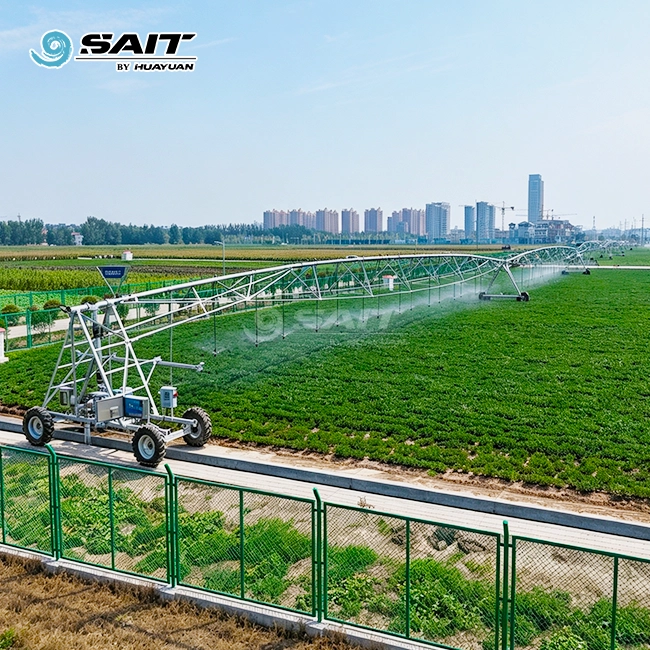
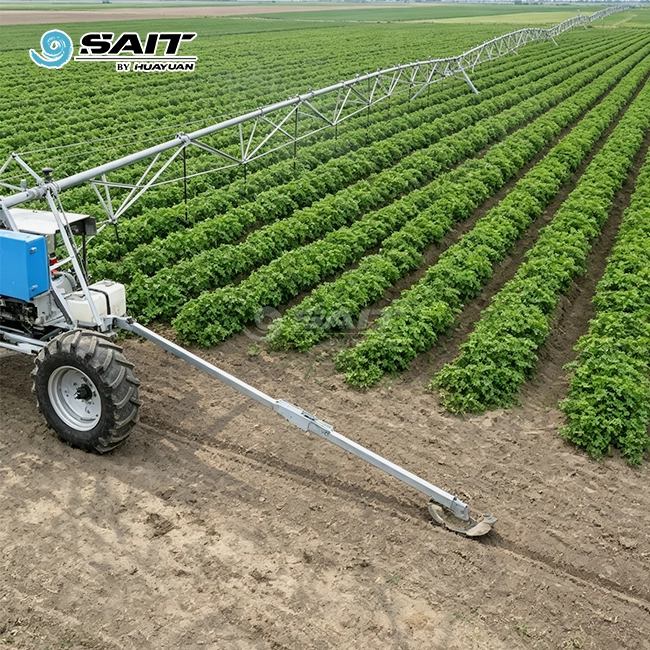
A corner arm system solves the uncovered area problem by extending irrigation coverage beyond the circular path of a standard center pivot. Traditional pivots leave up to 21% of a square field unirrigated at the corners. The swing arm unfolds as the pivot approaches each corner, guided by BDS/GPS positioning, and retracts once the pivot passes. Each nozzle along the arm fires independently, controlled by programmable solenoid valves, delivering water precisely where the main pivot cannot reach. The result is a measurable improvement in land utilization across square, rectangular, and irregularly shaped fields.
The Corner Coverage Gap That Costs Growers Real Money
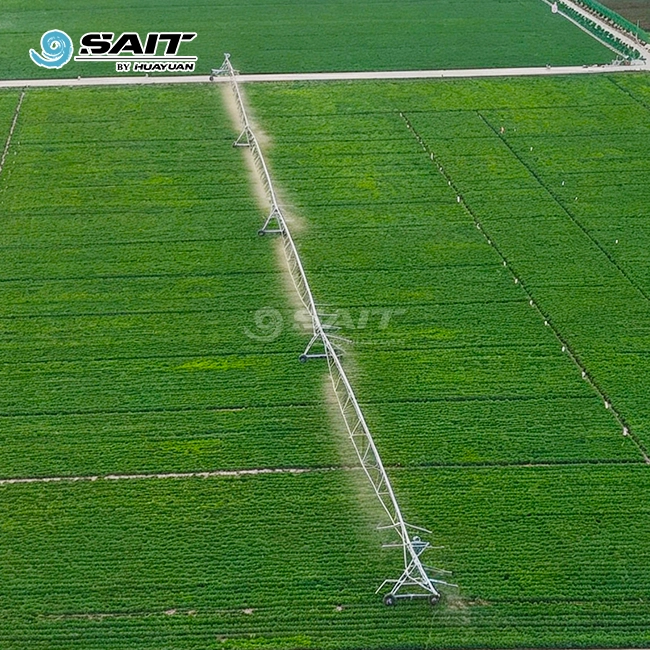
A standard center pivot makes a circle that is perfectly round. On a square quarter-section, that geometry leaves four triangle-shaped wedges with no water at all. According to research from the University of Nebraska–Lincoln, parts of a typical 160-acre field that are not watered waste about 34 acres of land that could have been used for farming. At the prices of commodities right now, those acres are worth a lot of money over the course of a full growing season.
Why Traditional End Guns Fall Short
The reach of end guns is longer, but the spray pattern isn't controlled and changes with the wind. They don't always follow the exact shape of a field boundary, and they don't always apply water evenly across the corner zone. End guns cause as many overlap issues as coverage gaps on uneven plots, which are common in Africa, Central Asia, and some parts of the Midwest in the United States.
The Scale of the Problem on Large Operations
When industrial farms that manage 500 hectares or more lose 15–21% of their field coverage, they lose the chance to get a better yield, pay more per unit for water, and waste fertilizer that is applied through fertigation. It's the same math problem that government state farms and EPC companies who build turnkey irrigation infrastructure have to deal with: not enough coverage hurts the system's ability to grow crops and make money.
How does the HUAYUAN SAIT Corner Arm System work?


You can find the HUAYUAN SAIT pivot corner arm system at the end of the final pivot span. It is a precision swing extension. The arm extends into the corner zone as the main pivot turns, and then automatically retracts. This is all controlled by BDS guidance, which has a wheel track accuracy of ±15 cm. No hidden wires. No need for human help.
Intelligent Nozzle Control via Solenoid Valves
Along the corner arm, the SAIT variable rate irrigation system manages 48 separate solenoid valves. Based on real-time GPS/BDS positioning data, each nozzle pulses on and off on its own, making sure that the flow rate is perfectly matched to the area being watered at any given time. With this pulse-width modulation method, the consistency of watering is above 90%, which is higher than the industry average of below 80%. No watering is missed, so the rate stays below 5%.
This unit's pipe width is 168 mm, and it can spray up to 110.7 m away and still work well. The system can be set up with either an end nozzle or an end gun, so workers can choose the best end-irrigation package for the shape of the field line.
Structural Integrity Under Field Conditions
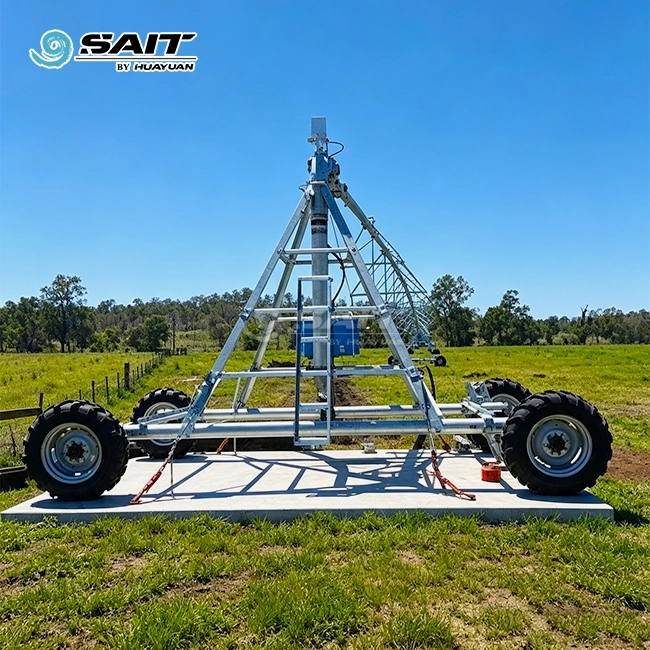
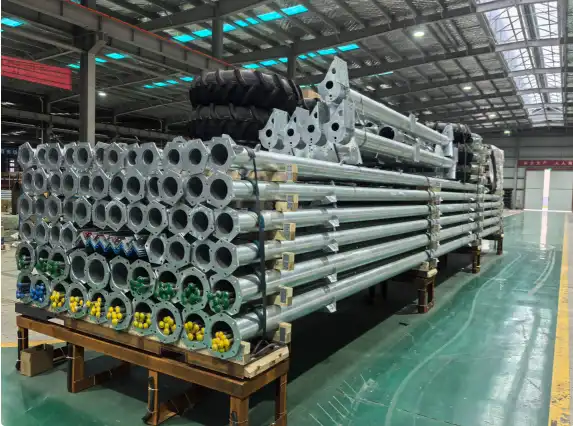
This design doesn't just throw in durability for fun. The span is mounted on a wide-profile T-bar that stays stable in high winds, which is very important for activities in North Africa, the Middle East, and open areas. The hinge points wear less when the track roller link has bigger rollers and new wear plates. The drive unit's dual-tower bracket spreads the load, which increases service life without adding steering force.
All steel parts are protected by hot-dip galvanizing at over 80 µm. The thickness of that zinc layer is better than regular galvanized coatings, and it makes the structure usable from -20°C to 60°C, so it can be used in both hot, dry conditions and temperate continental zones.
What Makes This Approach Different from Conventional Pivot Accessories?
In terms of technology and operations, the HUAYUAN SAIT corner arm configuration is better than older ones in the following ways:
- BDS/GPS-guided automatic operation means that no buried guide cables are needed. The arm moves through the corner zone using satellite positioning. This makes installation easier for both new and old projects and lowers the risk of long-term upkeep for wire systems that rust or move over time.
- 48-unit individual solenoid valve control means that applying water along the corner arm is not a single on/off event. Each nozzle reacts to exactly where it is in the field border. This stops too much application at the edge and too little application near the main pivot path, which is a typical way for simpler swing arm designs to fail.
- An effective spraying range of 81–110.7 m works well on big plots with corner zones that are far apart. The 168 mm pipe diameter keeps the pressure steady along the whole length of the arm, so normal setups don't need any extra booster pumps.
- 20-year manufacturing background and 130+ patents, including 35 invention patents and 15 foreign patents, and 20 years of experience making things, back the tech behind every part. HUAYUAN SAIT works with China Agricultural University to create technology and is part of a provincial engineering research center. This gives the product line R&D qualifications that can be checked.
A Pivot with corner arm provides these benefits for commercial farms, EPC contractors, and government agricultural agencies, directly addressing the problems that they hear about most often: coverage completeness, uniformity, reliability, and long-term structural durability.
Intelligent control, tried-and-true mechanics, and corrosion-resistant construction make it possible for workers to get back to corner production without making their watering program more difficult to manage.
Installation, Maintenance, and After-Sales Support
For every corner arm deployment, HUAYUAN SAIT oversees the installation and gives technical advice. Before deciding on the final span layout and nozzle package, engineers look at the field geometry, the state of the soil, and the power supply configuration. Before turning over to the operator, installation teams check the quality of the BDS signal and set the order of the solenoid valves.
Maintenance Expectations Over the Product Lifecycle
For a pivot with corner arm, the swing joint, wear plates, and solenoid valve seals are the main parts of routine maintenance. HUAYUAN SAIT suggests checking the rotating seal assembly once a year and greasing the track roller connection every 500 to 1,000 hours of use. The 80 µm hot-dip galvanizing layer makes maintenance for corrosion a lot easier in humid, coastal, and high-salinity places.
After the sale, there is a full guarantee for one year, low-cost upkeep and part replacement for three years, and spare parts for life at the original cost price. That promise to provide spare parts takes away a big supply chain risk for foreign buyers who are in charge of projects with guarantees that last for more than one year.
Conclusion
A well-designed corner arm system does more than just add a mechanical part to an existing pivot. It fills in a real-world economic and agricultural gap that affects all circularly irrigated fields, whether they are square or not. When the HUAYUAN SAIT corner arm is guided by BDS navigation and controlled by 48 individually controlled solenoid valves, it can water evenly in corners that regular pivots can't reach by more than 90%. This system gives large operators, engineering contractors, and government procurement teams a technically sound and cost-effective way to cover the whole field. It is backed by 20 years of manufacturing experience, more than 130 patents, and a full after-sales program.
FAQ
Q1: How much additional field area does a corner arm system typically recover?
A properly set-up pivot corner arm can recover about 15–21% of a standard square field's total area that would not have been watered otherwise. The exact number varies with the shape of the field, the length of the arm, and how the GPS/BDS navigation system is programmed to define the boundaries.
Q2: What happens if the BDS signal is interrupted during operation?
There is a backup procedure in the SAIT control system. If the positioning data isn't accurate enough, the system falls back to a safe retraction process and stops the turn to keep the boundaries from being crossed or the nozzle from activating without being controlled.
Q3: Can the corner arm be configured for irregular field boundaries?
Yes. The BDS-guided control system can use custom field boundary coordinates, which let the chain of solenoid valves follow borders that aren't square or rectangular. This means that the system can be used in areas that don't follow normal geometry, like those with roads, rivers, or property line angles that aren't straight.
Q4: Is the system compatible with third-party farm management platforms?
As part of its OEM and custom engineering service, HUAYUAN SAIT lets third-party SCADA and farm management tools work with its own. The language of the control panel, the layout of the user interface, and the formats for data output can all be changed to fit the needs of an existing platform.
Connect with HUAYUAN SAIT for a Corner Arm System Quote
The HUAYUAN SAIT corner arm system provider has been making these systems for 20 years and has BDS-guided precision technology ready to help you with your next irrigation job. For custom setups, we can take pilot orders for a single unit, and we can deliver in as little as one week from our plant near Xuzhou. You can email our technical team at kevin@showyirrigation.com to get engineering advice specific to your field and a competitive project price.
References
1. Camp, C.R., Sadler, E.J., & Busscher, W.J. (1997). A comparison of uniformity measures for drip irrigation systems. Transactions of the ASAE, 40(4), 1013–1020.
2. Evans, R.G., & King, B.A. (2012). Site-specific sprinkler irrigation in a water-limited future. Transactions of the ASABE, 55(2), 493–504.
3. Lyle, W.M., & Bordovsky, J.P. (1983). LEPA corn irrigation with limited water supplies. Transactions of the ASAE, 26(3), 829–835.
4. Sadler, E.J., Camp, C.R., Evans, D.E., & Millen, J.A. (2002). Spatial variation of corn response to irrigation. Transactions of the ASAE, 45(6), 1869–1881.
5. Howell, T.A. (2003). Irrigation efficiency. Encyclopedia of Water Science, Marcel Dekker, 467–472.
6. Kincaid, D.C., & Heermann, D.F. (1974). Scheduling irrigations using a programmable calculator. USDA Agricultural Research Service, ARS-NC-12.
Get a tailored irrigation solution for your project — our engineering team is ready to support you from design to installation.