Steel Cable Guidance Maintenance Tips for Long-Term Performance
Proper maintenance of a steel cable guidance system is one of the most cost-effective decisions any irrigation equipment operator can make. On a linear move irrigator, the wire rope tracking assembly keeps each drive unit traveling in a perfectly straight path across rectangular fields. When that cable wears unevenly, corrodes, or loses tension, the entire machine drifts—damaging crops, wasting water, and accelerating structural fatigue. This guide walks through practical, field-tested steps to keep your cable tracking system accurate season after season.
Understanding Steel Cable Guidance Systems and Common Maintenance Challenges


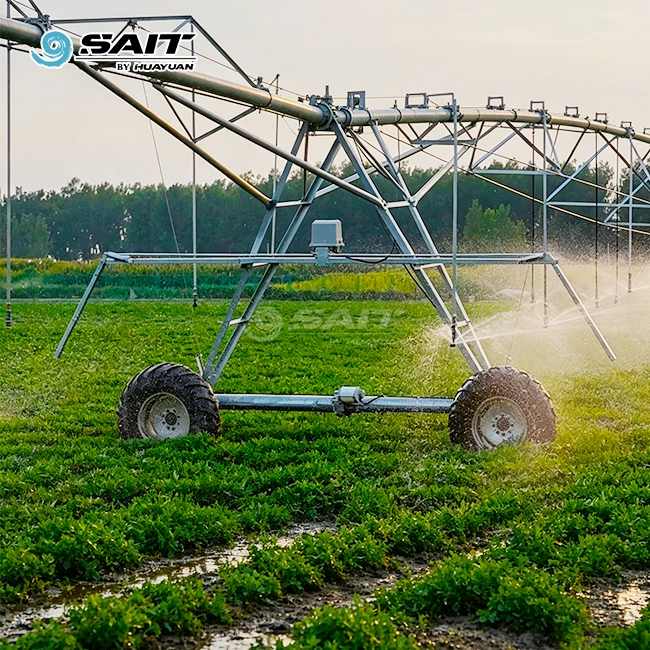
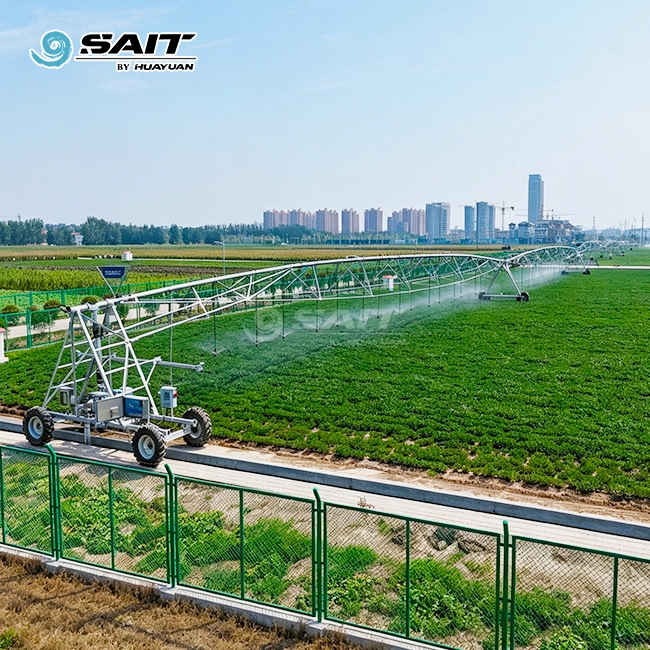
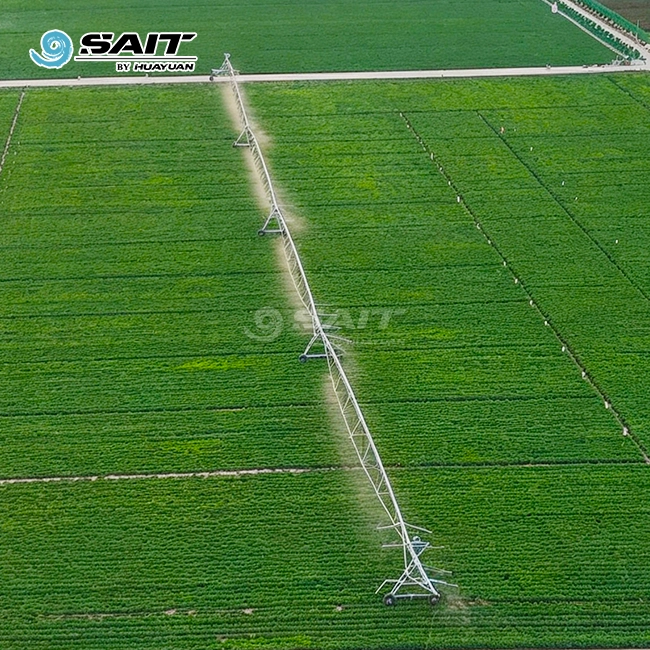
A tensioned wire rope laid across the field acts as a guide for a cable-guided lateral move irrigator. Sensor wheels, also called guide rollers, figure out where the wire is and tell the drive motors to make the necessary adjustments. This keeps the machine straight on the path. Linear irrigation systems from HUAYUAN SAIT have three guidance options: furrow, cable, and BDS/GPS dual-mode satellite. This gives operators the choice of which guidance method to use based on the field conditions and budget.
How the Wire Rope Tracking Assembly Works
It is made of steel and goes the whole length of the field (up to 3,000 meters on HUAYUAN SAIT units). As the machine moves forward, guide sheaves on each drive cart keep the fleet angle fixed. Any slack, kink, or surface corrosion in the wire, which works as a fixed point of reference, causes the line to move laterally.
Common Failure Points in Cable Tracking Systems
In the field, three types of failure happen most often:
- Surface corrosion and pitting — Moisture and fertilizer residue attack unprotected wire strands, reducing tensile strength by up to 30% before visible fracture occurs (ASABE Standard EP458).
- Groove wear on guide sheaves — Once the groove diameter exceeds the nominal cable diameter by more than 10%, the rope begins to ride unevenly, causing inconsistent tension readings.
- Tension loss from soil settlement — Anchor posts shift seasonally, particularly in sandy or clay-heavy soils, allowing the cable to sag and trigger false correction signals.
Root Causes Most Operators Overlook
Groove wear on guide sheaves: When the groove diameter is more than 10% larger than the nominal cable diameter, the rope starts to ride unevenly, which makes it hard to get accurate tension readings and affects steel cable tracking.
Key Maintenance Tips to Ensure Long-Term Performance
Cable tracking systems are unpredictable because they break down slowly over time. Systematic maintenance stops this from happening. The tips below are set up by type of job to help your team make a plan that can be used again and again.
Inspection Schedule and What to Measure
At the beginning and end of each watering season, check the whole length of the cables. After 200 hours of use, do a mid-season review. When you do an inspection, look for:
- Cable surface for broken outer strands, kinks, or corrosion pits
- Sheave groove depth against the original nominal diameter (replace if wear exceeds 10%)
- Anchor post alignment and concrete footing integrity
- Sensor roller contact pressure and pivot-pin play
Lubrication: Choosing the Right Product
Use a penetrating wire rope lubricant that is based on mineral oil and has chemicals that stop rusting. Heavy grease on the outside of the wire will trap rough dirt particles and speed up groove wear, so stay away from it. The temperature range that HUAYUAN SAIT machines are made to work in is -20 °C to 60 °C. For the guide sheave bearings, an NLGI Grade 2 lithium-complex grease works well.
Cleaning and Environmental Protection Strategies
Flush the cable and sheave assemblies with low-pressure water after each season to get rid of fertilizer salt buildup. The salt left over from fertigation processes is especially corrosive; even a short rinse makes cables last much longer. Before storing machines for a long time in dry heat, put a small layer of penetrating oil on them to protect them from oxidation caused by desert reclaiming zones, which is common in projects in the Middle East and North Africa.
Advanced Strategies for Optimizing Steel Cable Guidance Performance
When operators go beyond reactive repair and start structured performance plans, parts last longer, and there are fewer breaks in the middle of the season.
Integrating Sensor-Based Monitoring
Modern horizontal move controls can keep track of the number of correction signals over time. If the correction rate goes up between passes, it means that the wire or guide wheel is wearing out early, before the drift is noticeable. By adding this information to a simple spreadsheet log, maintenance staff can plan for planned downtime instead of emergency stops to retension cables.
Upgrading to Corrosion-Resistant Components
If the soil is acidic, has a high salt content, or is constantly in contact with fertilizer, you should use galvanized wire rope with a hot-dip finish that is at least 80 µm thick and stainless-grade sheave shafts for reliable steel cable guidance. All structural steel parts at HUAYUAN SAIT are hot-dip galvanized over 80 µm, which is a standard that works better than standard electro-galvanized parts in long-term field exposure.
Operator Training and Skills Investment
Even the most durable cable tracking assembly doesn't work well when operators don't know how to read correction signals. A one-day workshop on calibration that goes over adjusting the fleet angle, tightening the anchor posts, and setting the gap between the sensors and rollers pays for itself in the first season. As part of every project delivery, HUAYUAN SAIT offers on-site installation help and training for operators.
Comparing Steel Cable Guidance Maintenance with Alternative Guidance Systems
Operators can make smart choices about long-term running costs when they know how wire tracking stacks up against other guidance methods.
Cable Guidance vs. Furrow Guidance
A trench that is cut into the ground every season is used for furrow guiding. It doesn't need any upkeep on the wire rope, but the hole needs to be prepared every year, and irrigation water flow can wear it down. Cable guidance costs more to install at first, but it gets rid of the need for seasonal trench labor. On fields larger than 100 hectares, the cost is usually recovered in two to three seasons.
Cable Guidance vs. GNSS Satellite Guidance
GNSS (BDS/GPS dual-mode) guidance gets rid of the cable completely, so maintenance doesn't have to worry about wire rope wear. The downsides are that the technology is more expensive to buy at first and works only in places with good signal quality. GNSS guidance has the lowest long-term upkeep cost for tasks that need to be precise and where the investment is supported by field funds. All three guidance modes are available on the same machine platform from HUAYUAN SAIT, so operators can upgrade without having to buy a whole new unit.
Cost and Downtime Comparison
A HUAYUAN SAIT lateral move with a well-kept cable guide system only needs one new cable every five to seven seasons, and the costs of lube and sheave inspections once a year are low compared to the total cost of running the move. On the other hand, chain guidance systems need to be oiled more often and are more likely to get stuck on trash, which makes them less useful for open-field row crop treatments.
Selecting Reliable Steel Cable Guidance Suppliers and Services for Maintenance Support
Not only does picking the right steel cable guidance manufacturer affect the price of the machine, but it also affects how much it costs to run over its lifetime.
Key Criteria for Supplier Evaluation
When choosing a steel cable guidance supplier, look for written standards for corrosion protection, promises that spare parts will be available, and field references that can be checked. HUAYUAN SAIT stands behind its systems with a full guarantee for one year, low-cost upkeep and part replacement for three years, and lifelong supply of spare parts at factory cost price. These terms are very important for businesses that are located in remote areas where it can be hard to find replacement parts.
Benefits of OEM and Custom Configuration Support
A lot of the time, project developers and government irrigation officials need configurations that aren't available in standard catalog items. OEM and ODM customization is possible at HUAYUAN SAIT. The span lengths range from 37.5 m to 54.9 m, the pipe diameters range from 168 mm to 219 mm, and the drive units can be set up with two or four wheels. It takes 30 to 45 days for engineers to work on custom projects.
Long-Term Parts Availability and Technical Support
Standardizing parts is important for big cooperatives that run fleets of ten or more lateral move units. The fact that HUAYUAN SAIT can make 1,800 units a year and is located next to Xuzhou makes it easy to get parts and get them quickly. This is a practical benefit that procurement teams in the CIS region, North Africa, and Sub-Saharan Africa have found very useful.
Conclusion
A wire tracking system stays in good shape by being inspected regularly, oiled properly, and having the tension adjusted on time, ensuring reliable steel cable guidance. When operators follow a structured repair program, parts last much longer, unplanned downtime is cut down, and the straight-line movement accuracy that makes lateral move irrigation useful on rectangular fields is kept up. The upkeep habits in this article are the same whether you run three units or thirty. Good field practice and tools made to consistent manufacturing standards are the best ways to make sure your business will run well for a long time.
FAQ
Q1: How often should I inspect the wire rope on a lateral move irrigator?
Inspect the cable at the start and end of each irrigation season, plus a mid-season check after the first 200 operating hours. In high-salinity or sandy soil environments, increase the mid-season check to every 100 hours.
Q2: What signs indicate that the cable needs immediate replacement?
Replace the cable when you find more than two broken outer strands per lay length, visible kinking, corrosion pitting that has reduced the visible strand diameter, or when the machine shows persistent lateral drift despite correct anchor tension.
Q3: Does cable guidance work on sloped fields?
Cable guidance performs best on level terrain. For fields with a gradient exceeding 5%, GNSS satellite guidance is a better option because it maintains accuracy independent of anchor geometry changes caused by soil movement on slopes.
Q4: Can I switch from cable guidance to GNSS guidance on an existing unit?
Yes. HUAYUAN SAIT's modular platform design allows guidance mode upgrades without replacing the main structural components of the machine.
Contact HUAYUAN SAIT for Your Steel Cable Guidance Supplier Needs
HUAYUAN SAIT has been making lateral move irrigation systems for 20 years and is trusted by rectangular farm businesses all over the world. Our steel wire guidance systems with reliable steel cable guidance are fully OEM-customizable and come with a promise to provide extra parts for life. The structure is also hot-dip galvanized for added protection. To get a technical consultation and project quote right away, email Kevin@showyirrigation.com with the details of your field.
References
1. American Society of Agricultural and Biological Engineers (ASABE). ASABE Standard EP458: Field Evaluation of Microirrigation Systems. ASABE, 2021.
2. Food and Agriculture Organization of the United Nations. Irrigation Water Management: Irrigation Methods. FAO Irrigation and Drainage Paper No. 45, FAO, 2019.
3. Irrigation Association. Landscape Irrigation Best Management Practices. Irrigation Association, 2020.
4. International Wire & Machinery Association. Wire Rope Users Manual, 5th ed. IWMA, 2018.
5. Keller, Jack, and Ron Bliesner. Sprinkle and Trickle Irrigation. Van Nostrand Reinhold, 1990.
6. Evans, Robert G., and Edward J. Sadler. "Methods and Technologies to Improve Efficiency of Water Use." Water Resources Research, vol. 44, no. 7, 2008.
Get a tailored irrigation solution for your project — our engineering team is ready to support you from design to installation.